
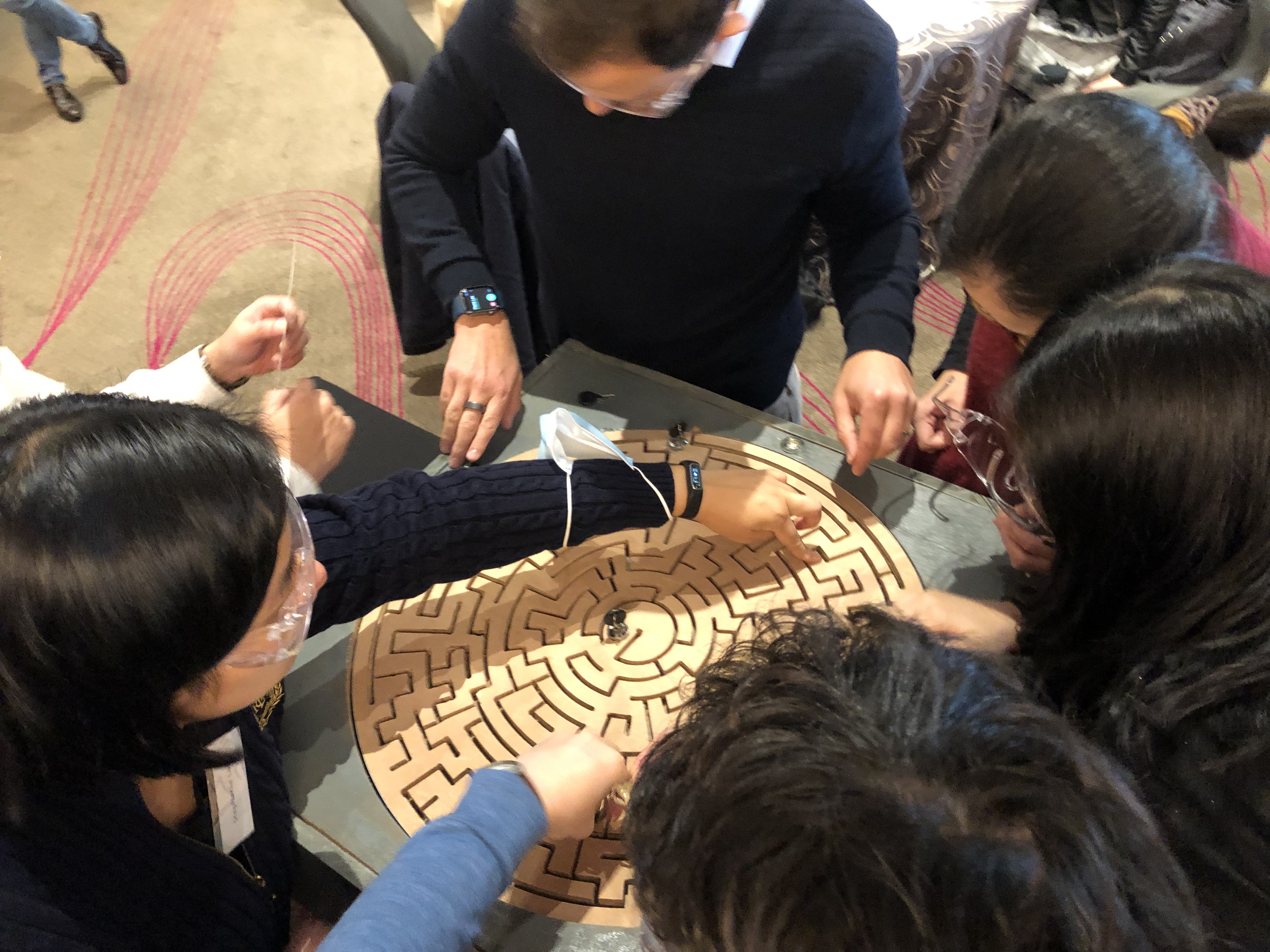
Inclusive intent becomes meaningful when people can see how it affects the way a team communicates, makes decisions and works towards a shared goal.
The first article in this series explored the design choices that help more people contribute. These include thinking time, varied roles, clear instructions and decision-making processes that consider different perspectives.
The next step is practice.
A facilitated team experience gives people a shared situation in which they can test these behaviours, notice their habits and discuss what they want to carry back into work.
Begin with the behaviour the team wants to strengthen
Diversity and inclusion can cover a wide range of organisational priorities. A team may want to improve listening, build awareness of different communication preferences or create more confidence in cross-functional discussions.
Others may need to explore values, fairness, leadership behaviour or participation under pressure.
Defining that objective first makes it easier to select an experience and shape the debrief. It also prevents the activity itself from becoming the goal.
Useful starting questions include:
Where does the team need a wider range of perspectives?
Which colleagues find it easiest or hardest to contribute?
How are differences currently discussed?
What behaviour should participants practise?
What should become easier after the experience?
The answers guide choices about format, group composition, challenge level, facilitation and reflection.
Make contribution visible and meaningful
Inclusive participation becomes easier to understand when teams can see how different contributions affect a shared result.
In a facilitated challenge, one person may notice a detail, another may organise the information and someone else may test the proposed solution. Success depends on how those contributions connect.
Integrity creates this type of environment through a series of three-dimensional problem-solving tasks. Teams communicate, make decisions and consider how fairness, feedback and accountability influence performance.
The format allows facilitators to explore questions that also matter at work. Did participants listen before deciding? How did they respond to feedback? Did the pressure change how they treated other people’s ideas? How did the team balance performance with its stated values?
The experience provides the shared evidence. The debrief turns that evidence into learning.
Build self-awareness before asking people to adapt
Inclusion also requires an understanding that colleagues may interpret information, respond to pressure and communicate in different ways.
A team can value difference in principle while still assuming that everyone prefers the same pace, level of detail or style of discussion. Self-awareness helps participants recognise these assumptions and make more deliberate choices.
Colour Assessment introduces four memorable preference styles. Participants explore their own tendencies, consider the strengths and challenges associated with each style and discuss how different preferences interact.
The aim is not to place people in fixed categories. It is to give the team accessible language for discussing how people work.
One colleague may want to understand the logic and supporting information before committing. Another may focus on practical action. Someone else may look first at relationships or the wider possibilities.
Recognising these preferences can help teams communicate more clearly, adapt their approach and respond to difference with curiosity.
Create several routes into the challenge
Inclusive design gives participants more than one useful way to support the group.
Some people may be comfortable presenting ideas. Others may contribute through observation, navigation, analysis, coordination or practical execution. A shared challenge can help the team value these roles while keeping everyone connected to the same objective.
Escape The Maze combines puzzles, ciphers, navigation and strategic choices in an indoor or outdoor format. Participants use a tablet and an Action Pack to follow routes, unlock checkpoints and respond to changing information.
The varied nature of the experience creates opportunities for different strengths to emerge. Teams can also rotate responsibilities so that more people influence the journey.
For larger or mixed groups, this flexibility matters. Escape The Maze can be adapted for groups ranging from 10 participants to more than 500, giving organisations options for conferences, offsites and company-wide events.
The facilitator can then draw attention to how the group assigned roles, shared information and included different perspectives in its decisions.
Practise inclusion when the team is under pressure
A team’s inclusive habits are often tested when time is short or the task is unfamiliar.
Pressure can narrow attention. People may move quickly to the first available idea or rely on the colleagues who usually take the lead. A structured activity allows teams to notice this tendency in a contained setting and practise a broader response.
Drone Control asks participants to decode illustrated instructions, assign responsibilities, practise manoeuvres and fly drones through a series of obstacles. Each participant takes a turn, while the wider team supports planning, observation and improvement.
The rotating roles help connect individual participation with collective performance. Teams need to communicate clearly, learn from each attempt and adapt their approach.
This creates useful reflection around access to responsibility. Who received guidance? How did the team respond to mistakes? Did everyone have the information and support needed to contribute? How did the group improve together?
These questions connect the experience with everyday moments such as onboarding, project delegation and learning new technology.
Match the format to the people
No single activity is inclusive for every group.
The choice should consider the people attending, their access requirements, language needs, venue, group size and desired level of physical activity. Participants should receive enough information in advance to understand the format and raise relevant requirements.
The following comparison provides a practical starting point:
Experience | Format | Duration | Group size | Useful focus |
|---|---|---|---|---|
Integrity | Indoor or outdoor | 2–3 hours | 10–150 | Values, fairness, feedback and accountability |
Colour Assessment | Indoor | 1.5–2.5 hours | 10–150 | Self-awareness and communication preferences |
Escape The Maze | Indoor or outdoor | 1.5–2.5 hours | 10 to 500+ | Varied contributions, communication and shared decisions |
Drone Control | Indoor or outdoor | 1.5–2.5 hours | 10–250 | Rotating roles, technology, adaptability and coordination |
These specifications help narrow the options, but they should not replace a conversation about the team.
The strongest recommendation will take into account what participants need and what the organisation wants them to practise.
Connect the debrief with everyday work
An enjoyable shared experience can open the conversation, but the learning becomes useful when it connects with a real workplace moment.
The facilitator might ask participants to identify:
One contribution the team might previously have overlooked
One communication habit they want to adapt
One way to gather wider input before a decision
One responsibility that could be shared or rotated
One action leaders can take to make participation easier
The team should leave with a small number of practical commitments. These might include sharing meeting questions in advance, rotating project roles or checking whose perspective has not yet been considered.
The commitments need to be clear enough for people to recognise when they are being applied.
Turn inclusive intent into repeated behaviour
Inclusion grows through repeated experiences of being able to contribute and influence the work.
A facilitated activity gives teams a place to notice how they interact, experiment with different approaches and build a shared language for improvement. The chosen program supports the process, while the outcome remains the focus.
Explore Team Building Asia’s Diversity & Inclusion experiences or learn more about our Learning & Development solution.
For a recommendation based on your team, group size and objectives, contact Team Building Asia.
Frequently asked questions
Which team experience is best for discussing values?
Integrity creates a facilitated setting for exploring fairness, feedback, accountability and how values influence decisions and behaviour.
Which experience supports different communication styles?
Colour Assessment helps participants understand communication preferences and discuss how to adapt when colleagues process or express information differently.
Are there inclusive activities for large groups?
Yes. Escape The Maze can accommodate groups ranging from 10 to more than 500 participants. Suitability still depends on the venue, accessibility requirements and intended outcome.
Can technology-based activities support inclusion?
Yes, when roles and responsibilities are thoughtfully designed. Drone Control allows participants to rotate roles while supporting one another through planning, practice and feedback.